The Stuff of Invisibility: A Materials Shopping List for the Next Stealth Era
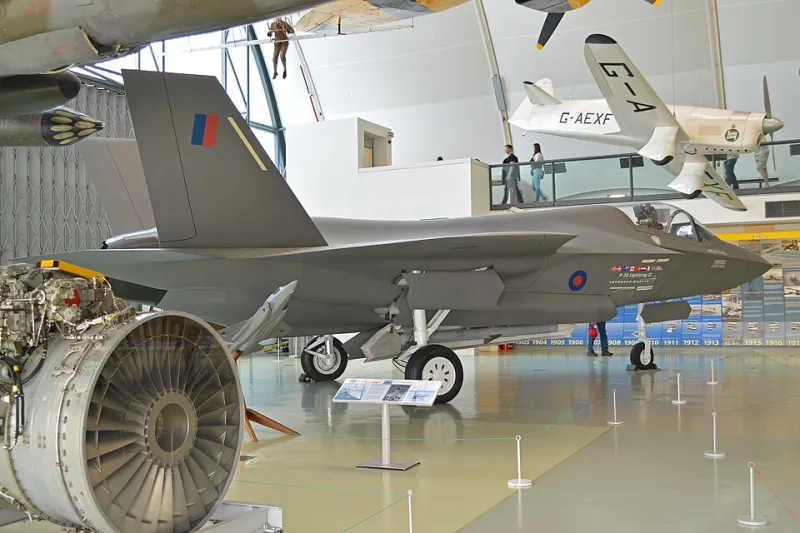
Photo: Alan Wilson from Stilton, Peterborough, Cambs, UK, CC BY-SA 2.0, via Wikimedia Commons
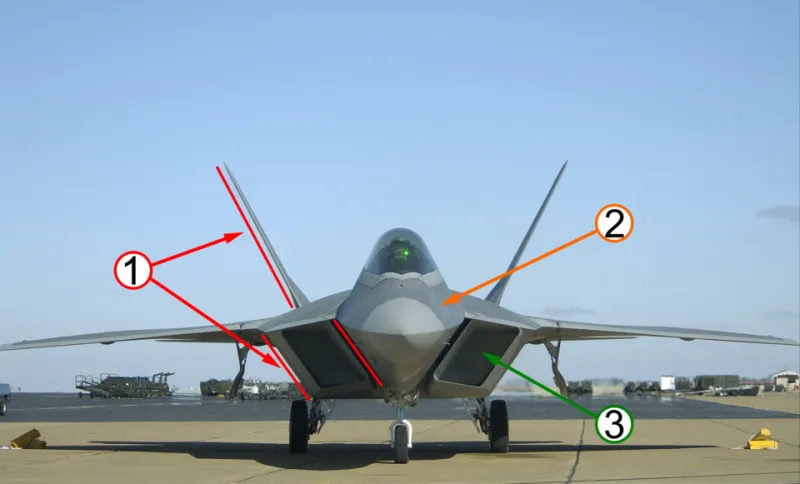
Ask a layperson how stealth works and they will describe the shape — the flat facets of the F-117, the blended curves of the F-22. Ask a materials scientist and you will get a very different answer, one involving impedance matching, ferrite-loaded paints, and carbon-black chemistry. Shape may set the baseline, but materials determine whether that baseline survives rain, hangar time, carrier operations, and Mach 5 heating. Here are five material families that will decide how well the next generation hides.
1. Radar-Absorbing Metamaterials
Metamaterials are engineered structures whose repeating sub-wavelength patterns produce electromagnetic behavior no natural material can match. In stealth applications, the promise is absorption tuned to specific frequency bands — including the meter-wave bands where conventional RAM performs poorly — without the thickness and weight penalties of legacy absorbers.
The trade-off is manufacturing reality. A metamaterial is a precisely structured surface, often fabricated layer by layer, and scaling laboratory performance to an aircraft-sized skin at flight-line tolerances remains the central challenge. Defense primes and university affiliates, including work spun out of programs at AFRL and DARPA's structural materials portfolios, are betting that additive manufacturing closes that gap.
2. Conductive Coatings and Transparent Skins
Canopy coatings are the unsung hero of stealth. A cockpit is a cavity bristling with radar-reflective hardware; gold or indium-tin-oxide films on the canopy let pilots see out while keeping radar energy from getting in and bouncing back. The next step is broader: coatings and films that manage static charge, dissipate lightning current, and maintain low observability across wider bands — all while surviving abrasion from rain, hail, and deck handling on a carrier.
The maintenance burden of legacy coatings is well documented; anyone who has read a GAO report on F-22 sustainment knows the story. The industry-wide push is toward coatings that are durable by design rather than maintained by man-hour.
3. High-Temperature Ceramic Matrix Composites
Hypersonics has made ceramic matrix composites — CMCs — the material of the moment. Silicon carbide and carbon-carbon composites retain strength at temperatures that would anneal aluminum and creep titanium, which makes them essential for leading edges, exhaust structures, and any airframe expected to survive sustained flight above Mach 4.
For stealth, the challenge is that hot leading edges are also radar-hot leading edges. A sharp, radar-friendly edge made of the wrong material becomes a plasma sheath or a cracked, scattering surface after one high-speed run. Programs across NASA, the Air Force Research Laboratory, and contractors like GE and Ceramatec are racing to produce CMCs that hold both their mechanical properties and their electromagnetic signature under thermal cycling.
4. Structural RAM and Load-Bearing Absorbers
The holy grail is absorber that is also structure — a wing skin that carries flight loads while eating radar energy. Every pound of dedicated RAM that can be replaced by load-bearing absorber is a pound returned to fuel, payload, or range.
Sandwich structures with absorbing cores, fiber-reinforced composites with lossy fillers, and graded-impedance laminates all point in this direction. The engineering headache is certification: a structural skin must meet fatigue, damage-tolerance, and repair standards while also meeting signature requirements, and the two qualification regimes were never designed to talk to each other.
5. Adaptive and Active Signature Materials
The most speculative entry is also the most interesting: materials that change their properties on command. Frequency-selective surfaces can be designed to be transparent to friendly radar bands and opaque to hostile ones. Active metasurfaces — absorbing structures with embedded tunable elements — could in principle let an aircraft reshape its own radar signature in flight, darkening up when a threat radar illuminates and relaxing when it does not.
This is research-phase work, heavily cloaked, and any confident claims about fielded capability should be treated with skepticism. But the direction of travel is clear: signature management is moving from a static, baked-in property toward something closer to a controllable system.
The Quiet Race
None of these materials will appear in a press release with a dramatic reveal. They will surface the way stealth materials always have — in sustainment contracts, in university partnership announcements, in the occasional patent filing. But the nation that masters absorbers it can afford to maintain, and ceramics it can afford to fly, will hold a real advantage in the next generation of contested skies. The shape gets the glory. The stuff makes it possible.