Salt, Swell, and Signature: The Separate Physics of Naval Stealth
The U.S. Navy’s stealth aircraft do not operate in the same electromagnetic world as their land-based counterparts. They launch from a moving steel island, recover into a crowded deck cycle, and spend their lives above a radar background that never stops moving. That distinction matters because low observability is not a fixed property of an airframe. It is a negotiated condition between the vehicle, the sensor, the environment, and the support system. At sea, all four terms change.
The Ocean Is a Radar Target
On land, a stealth aircraft’s signature is often discussed against a backdrop of terrain clutter, buildings, and ground-based emitters. At sea, the clutter is fluid. Wind-driven waves create a moving, textured radar return that varies with sea state, grazing angle, and radar frequency. For a low-flying aircraft approaching a surface group, the problem is not simply whether its radar cross section is small. The problem is whether that small return can be separated from a much larger ocean return whose statistics shift hour by hour.
This is why naval stealth cannot be reduced to a single RCS number. Maritime radars use Doppler processing and space-time adaptive processing to filter clutter, and those techniques improve as the target’s motion differs from the sea’s. But an aircraft maneuvering at low altitude over a rough surface presents a harder discrimination problem than one crossing a desert at medium altitude. The Navy’s carrier air wing therefore treats stealth as one layer in a maritime kill chain that includes electronic attack, passive sensing, and offboard targeting. The EA-18G Growler is not a supporting act to stealth; it is part of the same signature-management strategy.
Ducting and the Disappearing Horizon
The maritime atmosphere adds another variable that land-based signature analysts can sometimes ignore: anomalous propagation. Temperature and humidity gradients over the ocean can trap radar energy in ducts, extending detection ranges beyond the geometric horizon and bending radar paths in ways that are difficult to predict. A surface radar may suddenly see farther than its nominal range, or it may see nothing where a target should be. For stealth aircraft, ducting is a double-edged condition. It can expose a low-observable platform to an emitter that should have been over the horizon, and it can also create gaps and shadows that a tactician might exploit.
The practical result is that naval stealth planning leans heavily on atmospheric modeling and real-time electromagnetic reconnaissance. The aircraft’s signature is only one input. The fleet needs to know which radars are active, how the atmosphere is refracting their energy, and whether the sea clutter is masking or revealing. That is a different operational discipline from a land campaign in which terrain masking is relatively stable and emitter locations are more predictable.
Salt Is a Signature Issue
Low-observable sustainment is always demanding. At sea, it is punishing. Salt fog, humidity, and constant exposure to a corrosive environment attack the coatings, seams, and fasteners that help preserve a reduced signature. Carrier maintenance spaces are constrained, the deck is a industrial workplace, and the aircraft themselves are exposed to weather and exhaust. An Air Force stealth fleet can rely on climate-controlled hangars and depot-level coating facilities. A carrier air wing has to keep aircraft mission-capable inside a smaller logistical envelope, often farther from those depots than a land-based squadron would be.
This is not a minor housekeeping concern. Signature management is a maintenance discipline. Every panel gap, every fastener, every patch of degraded radar-absorbent material is a potential contributor to a larger return. Salt does not care about the elegance of the design. It works on the same surfaces that make the design effective. Naval stealth therefore carries a sustainment tax that is measured not only in dollars but in deck hours, specialized manpower, and the availability of repair materials at sea.
The Deck Is a Design Constraint
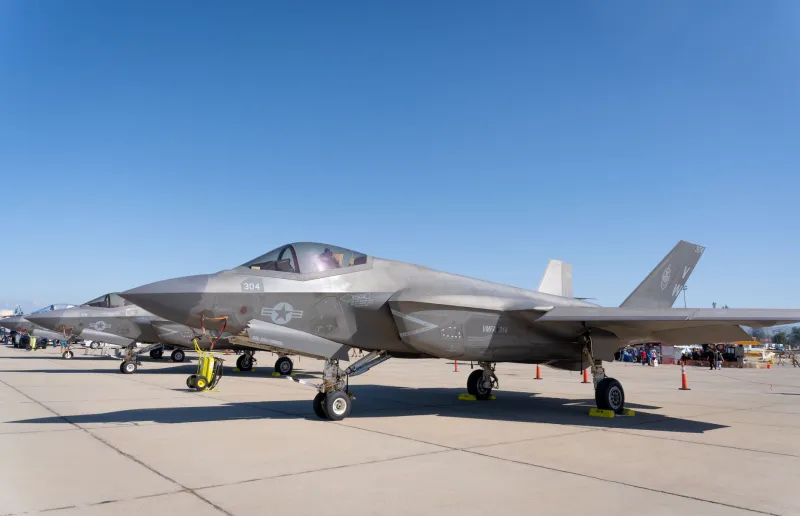
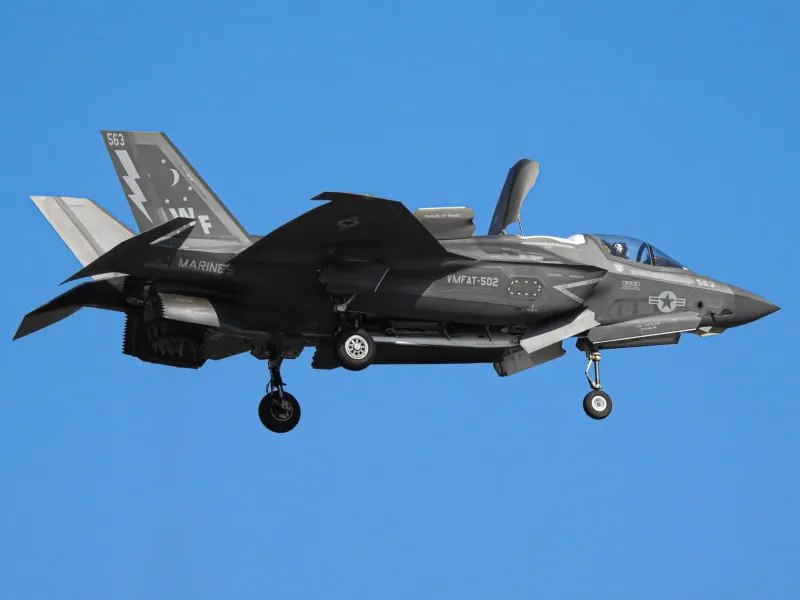
The carrier environment also shapes the airframe before it ever enters service. Folding wings, reinforced landing gear, a tailhook, and a structural design that can tolerate catapult launches and arrested recoveries all add weight and complexity. The F-35C reflects those compromises. It is not simply an F-35A with a different paint scheme. Its larger wing area and carrier-suitability features are part of the same design conversation that determines its signature.
Future naval combat aircraft will face the same tension. The debate over the Navy’s next-generation fighter is not only about whether it should be more or less stealthy than current types. It is about how much stealth can be carried aboard a carrier without sacrificing range, payload, survivability, and maintainability. A carrier air wing has finite deck space, finite tanking capacity, and finite maintenance hours. Every signature improvement has to earn its place in that cycle.
What the Navy Actually Buys
The current carrier air wing is a mixed force: F-35C Lightning IIs, F/A-18E/F Super Hornets, and EA-18G Growlers, supported by E-2D Hawkeyes and, increasingly, unmanned tankers. That mix is not a transitional accident. It reflects a naval view that stealth is powerful but not sufficient. The Super Hornet Block III carries networked sensors and weapons; the Growler disrupts and deceives; the F-35C contributes sensing and low observability. The synergy matters more than any single platform’s signature.
That is the central difference between naval stealth and the popular image of a solitary invisible aircraft. At sea, stealth is a team sport played against a moving radar background, in corrosive air, from a deck that never stops moving. The physics and the logistics diverge from the land-based model. Naval planners know it. The ocean makes sure they do not forget.