Ghostwriting in Silicon: The Code That Sketches America's Stealth Aircraft Before They Exist
The Pole Model Era
Before a stealth aircraft can hide from a radar, engineers have to guess how it will look to one. In the late 1970s, that guesswork was physical. Lockheed's Have Blue demonstrators were preceded by flat-plate models mounted on poles at test ranges, rotated through azimuth and elevation while radar returns were recorded and catalogued. Each iteration consumed months: cut metal, mount, measure, interpret, redesign. The cycle was slow, expensive, and constrained by how many shapes could be built.
The theoretical groundwork was already in place. Pyotr Ufimtsev's work on edge diffraction had shown that the radar signature of a complex body could be approximated by the contributions of its edges and surface discontinuities. Lockheed's Denys Overholser recognized that this was not merely an academic curiosity but a design tool: if you could compute the scattering from edges, you could design to minimize it. The first faceted stealth shapes were, in effect, hand calculations made real in aluminum.
What changed over the following four decades is where that calculation happens. Increasingly, it happens in software—before any metal is cut at all.
From Range to Rack
Computational electromagnetics, or CEM, is the discipline that predicts how electromagnetic energy interacts with structures. Its methods are varied: the method of moments for integral equations, finite-difference time-domain for broadband transient scattering, physical optics and shooting-and-bouncing rays for electrically large platforms, and multilevel fast multipole algorithms for problems that would otherwise exceed any reasonable memory budget.
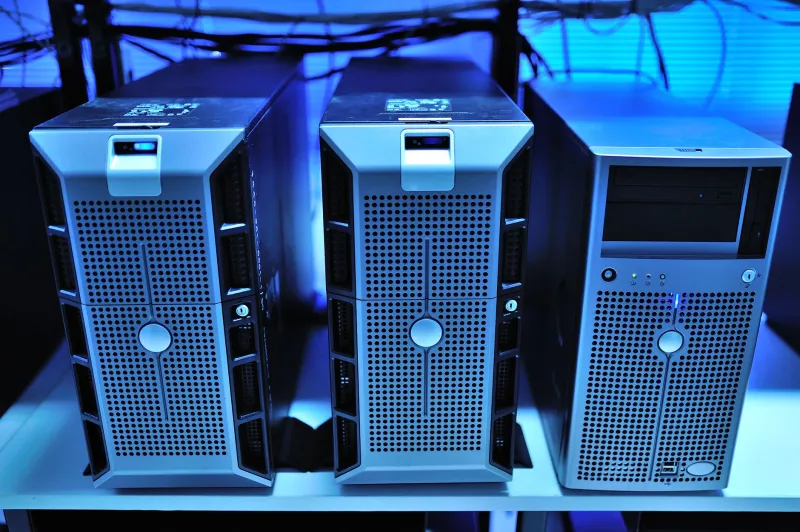
Each method carries tradeoffs in fidelity, frequency range, and computational cost. The practical American advantage is not any single solver—many are published, and commercial packages are widely available—but the ecosystem in which they run. The Department of Defense High Performance Computing Modernization Program provides supercomputing capacity to design teams that few commercial entities could justify. Codes are parallelized across thousands of processors, and the results are compared against measured data from instrumented ranges such as the Radar Target Scatter facility at Helendale and the National Radar Cross Section Test Facility at Holloman.
That comparison is the quiet heart of the enterprise. A solver is a hypothesis about physics. A validated solver is an institutional asset.
Designing in the Space Between Shapes
The second shift is subtler than raw compute. Early CEM answered a narrow question: given this shape, what is its signature? Modern design asks a broader one: among the infinite family of shapes that meet aerodynamic and structural requirements, which ones minimize signature across the threat bands that matter?
That is an optimization problem, and it changes the relationship between engineer and tool. Gradient-based methods, adjoint formulations, and surrogate models let design teams sweep thousands of candidate geometries before committing to a single wind-tunnel model. Materials are co-simulated—radar-absorbent structures, frequency-selective surfaces, and edge treatments are evaluated as part of the electromagnetic problem rather than as a coating applied afterward. The signature is no longer a property measured at the end of the program; it is a variable in the design loop from the first week.
The B-21 Raider is the most visible example of this approach. Northrop Grumman has described a digital engineering environment in which the aircraft was modeled, simulated, and in some sense "flown" before assembly. Public claims should be read with appropriate caution, but the direction is clear: the design record lives in software, and the physical aircraft is a confirmation of that record rather than the first draft of it.
Why the Moat Is Hard to Cross
It is tempting to treat this as a software problem, and therefore as a problem that can be solved by acquiring software. That reading misunderstands where the advantage sits.
A competent adversary can obtain CEM solvers. The literature is open; the methods are taught in universities; the commercial packages are sold internationally. What is not for sale is the calibration layer: decades of measured data against which predictions have been checked, the tacit knowledge of which numerical approximations fail where, and the workforce that knows how to interpret a disagreement between simulation and measurement. A radar cross section prediction is only as good as the last time someone proved it wrong and fixed the model.
There is also an integration advantage. American stealth programs are built inside companies that have iterated on low-observable design since the 1970s. Their simulation tools are wired into computer-aided design, manufacturing planning, and sustainment. When a panel gap changes on the factory floor, the signature model updates. That coupling is not a product; it is an organizational habit.
The Limits of a Perfect Prediction
None of this makes simulation infallible. CEM is only as good as the physics it encodes, and novel materials or unusual geometries can push a model into territory where validation data is thin. There is a real risk of what might be called simulation theater: a program that trusts its own predictions because they are internally consistent, without sufficient external truth data to challenge them.
That is why the ranges still matter. The anechoic chamber and the outdoor pole have not been retired; they have been repositioned. They now serve as calibration instruments for the digital surrogate rather than as the primary design loop. The most sophisticated stealth programs are those that treat measurement and simulation as a continuous conversation rather than a handoff.
The Next Stack
The next phase is already visible. Machine-learning surrogates can approximate expensive solvers at a fraction of the cost, enabling broader design sweeps. Differentiable simulators allow gradient information to flow through the electromagnetic model directly into shape optimization. These are promising tools, but they inherit the same dependency: they are only as trustworthy as the data used to train and validate them.
For allies and adversaries alike, the lesson is that stealth is not a shape you can photograph and copy. It is a stack—physics, code, data, ranges, and the people who keep them honest. The United States built that stack first, and it remains the most consequential piece of the low-observable enterprise. The shape of a shadow is now drafted in silicon, revised in software, and only then cut in metal.