The Ramp Radiates: Flightline Infrastructure and the Unshaped Signature
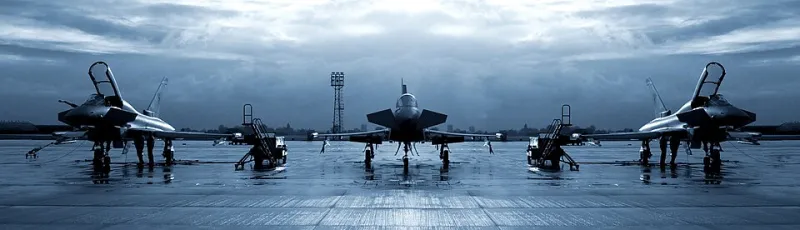
Photo: Cpl Morgan RAF, OGL v1.0, via Wikimedia Commons
Stealth analysis tends to begin and end with the aircraft. Radar cross section, infrared suppression, edge alignment, coating condition, and weapons-bay treatment are treated as the variables that matter. That framing is useful, but incomplete. A low-observable aircraft does not operate as a solitary object. It operates inside a flightline ecosystem, and that ecosystem radiates.
The Airframe Is Not the Only Emitter
On a typical ramp, a stealth aircraft may sit surrounded by mobile generators, power carts, maintenance test sets, airfield lighting, ground-support radios, and the ordinary electrical noise of a working base. None of that equipment was designed around signature control. It was designed for availability, maintainability, and cost. The result is a detectable perimeter that no amount of airframe shaping can erase.
This is not a new phenomenon, but it is an underappreciated one. Signature management has become increasingly sophisticated at the platform level. The supporting infrastructure has not kept pace. A squadron can spend years refining the radar-cross-section performance of an aircraft and then undermine the operational picture with a generator running in the open, a test set radiating through an unfiltered cable, or a maintenance radio operating at the wrong moment.
A Taxonomy of Ramp Emissions
The flightline signature problem is easiest to understand in three bands: radio frequency, infrared, and acoustic.
In the RF band, the principal offenders are rarely exotic. Mobile generators and power carts produce electrical noise that can couple onto cables and structure. Maintenance test sets may radiate intentionally during fault isolation. Ground-support radios and wireless diagnostic links add another layer. Airfield lighting, particularly when controlled or monitored through power-line or wireless systems, can contribute unintended emissions. Even ordinary electrical distribution around a hardened shelter can act as an antenna if it is not engineered with signature discipline in mind.
In the infrared band, the issue is heat. Generators, power carts, and vehicle engines produce thermal signatures that are persistent and difficult to conceal. A low-observable aircraft may be designed to manage its own thermal load, but the equipment around it can create a warm perimeter that is visible to infrared sensors regardless of the airframe's design.
In the acoustic band, the problem is simpler still. Generators, carts, and vehicles are loud. Acoustic sensing has its limits, but a flightline is not a quiet environment, and the noise profile of ground operations can reveal activity, timing, and location even when the aircraft itself is acoustically managed.
The Perimeter Problem
The operational consequence is that stealth is not only a platform property but a perimeter property. An adversary does not need to detect the aircraft directly if it can detect the activity around it. A generator running at a known location, a test set radiating during maintenance, or a ground radio transmitting at a predictable time can provide enough information to infer the presence and status of a low-observable aircraft.
This matters most in contested or observed environments. At a main operating base, the perimeter problem is largely theoretical because the base itself is a known location. But stealth aircraft are increasingly expected to operate from austere or expeditionary locations, where the surrounding infrastructure is less controlled and the detection geometry is less predictable. In those settings, the flightline signature can become the most observable thing on the ramp.
Base-Level Signature Discipline
The solution is not to eliminate ground-support equipment. That is neither practical nor necessary. The solution is to treat the flightline as part of the signature problem. That means including ground-support emissions in base-level signature planning, training maintenance crews to understand how their equipment contributes to the detection picture, and designing or procuring support equipment with emission control in mind.
Some of this is procedural. Generators can be sited and shielded. Test sets can be operated in enclosures or at times that reduce exposure. Ground radios can be used with disciplined emission-control protocols. Airfield lighting can be designed or modified to reduce unintended radiation. None of these measures is glamorous, but together they can lower the signature floor of the flightline.
Some of it is material. Support equipment could be designed with filtering, shielding, and thermal management as explicit requirements rather than afterthoughts. Power carts and generators could be selected or modified for lower infrared and acoustic signatures. Cables and connectors could be specified for emission control. These changes would add cost, but the cost may be small compared with the operational risk of an unshaped ramp.
The Procurement and Training Gap
The deeper issue is organizational. Platform signature management tends to be owned by specialized engineers and program offices. Flightline operations tend to be owned by maintainers and squadron leadership. The two communities do not always share the same vocabulary or the same priorities. Bridging that gap requires deliberate effort.
Training is one lever. Maintainers should understand that a generator is not just a power source but an emitter. Test-set operators should understand that a diagnostic transmission is also a detectable event. Squadron leadership should understand that the flightline is part of the signature picture, not a neutral backdrop.
Procurement is another lever. Requirements for ground-support equipment should include signature considerations where operational conditions warrant. That does not mean every generator needs to be stealthy. It means the trade space should be acknowledged and managed rather than ignored.
Conclusion
Stealth is often described as a property of the aircraft. In practice, it is a property of the operation. The airframe matters, but so does the ramp around it. As low-observable aircraft become more capable and more widely deployed, the supporting infrastructure becomes a larger part of the detection problem. The flightline is not invisible, and it was never designed to be. Recognizing that fact is the first step toward managing it.
In 2026, the signature conversation is increasingly about networks, sensors, and multi-domain detection. That is appropriate. But the conversation should also include the generator humming beside the shelter, the test set radiating through an open cable, and the ground radio transmitting on an unplanned frequency. Those are not glamorous topics, but they are part of the same problem. The ramp radiates, and stealth cannot shape away what it does not control.