The Decommissioning Signature: Why Retirement Is the Last Stealth Mission
A stealth aircraft is usually discussed in terms of what it does in the air: how little it reflects, how narrowly it radiates, how carefully its surfaces and edges manage incoming energy. But the end of an airframe’s flying career does not end its signature value. In some ways, retirement sharpens the problem. An operational aircraft is guarded by flight-line procedures, security cordons, and a clear military chain of custody. A retired one moves into a hazier world of storage depots, contractor facilities, museums, and disposal contracts. That transition is where low-observable secrecy can quietly become low-observable logistics.
The Airframe Is Not the Whole Secret
The public imagination treats stealth as a shape. The shape matters, but it is only one layer. Radar-absorbent materials, edge treatments, conductive coatings, fasteners, access-panel tolerances, and the seams where surfaces meet all contribute to a controlled signature. Many of those features are difficult to reverse-engineer from a photograph, but they are far easier to study up close. A retired aircraft sitting outdoors is not merely an old airplane. It is a physical sample of decades of design choices, material formulations, and manufacturing techniques.
That is why the end-of-life process cannot be reduced to “park it” or “put it in a museum.” The U.S. approach generally involves demilitarization and controlled disposal, but the details are rarely public for obvious reasons. The objective is not simply to remove weapons or sensitive electronics. It is to ensure that the airframe no longer offers a useful signature intelligence return to anyone who might gain access, legally or otherwise.
Demilitarization Is a Materials Problem
Radar-absorbent materials complicate disposal because they are not ordinary aircraft skin. Some are applied as coatings; others are embedded in structures or integrated into panels. Removing them can be labor-intensive, and the removal process itself may generate hazardous waste that must be handled under environmental regulations. The same materials that make an aircraft harder to detect can make it harder to dismantle responsibly.
There is also the question of what “demilitarized” means for a low-observable airframe. Stripping coatings may reduce one signature concern while leaving another: the underlying geometry, the treatment of inlets and exhausts, and the arrangement of surface features that were designed to manage radar returns. A demilitarization plan has to consider the whole airframe, not just the most visible coating.
In practice, retired stealth aircraft may be stored under controlled conditions, dismantled in secure facilities, or prepared for display with specific features removed or altered. Each path carries a different risk calculus. Storage preserves the option to return an airframe to service or use it for testing, but it also extends the period during which the asset must be guarded. Dismantling reduces the physical footprint but creates a chain-of-custody challenge for the resulting material. Museum display offers public education but requires a careful line between an authentic artifact and a useful intelligence sample.
The Museum Problem
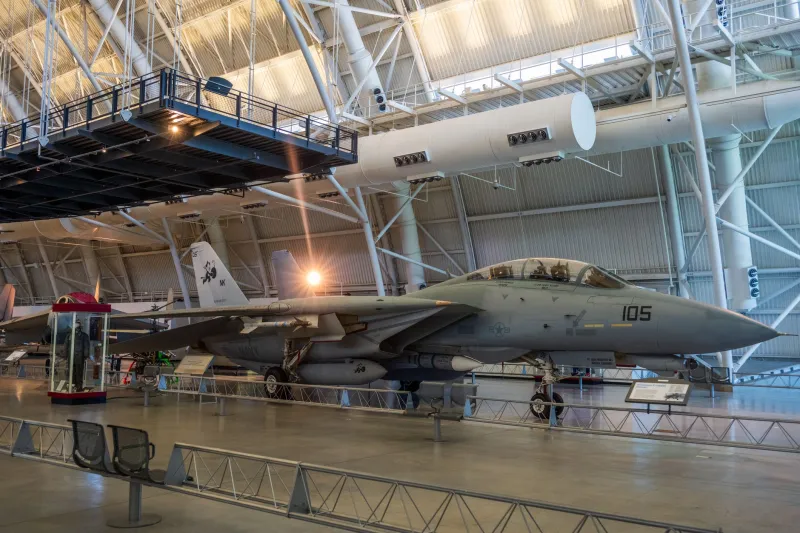
Museums are where the retirement problem becomes most visible to the public. The National Museum of the U.S. Air Force, the Smithsonian, and smaller institutions across the country hold or seek aircraft that once represented the leading edge of low observability. Displaying them raises legitimate questions: What can be shown? What must be removed? How much restoration is appropriate when restoration might reintroduce sensitive features?
A museum aircraft is not an operational aircraft, and it should not be treated as one. Curators and military officials often work with airframes that have been modified for display. Inlets may be blocked, coatings may be removed or replaced with non-representative materials, and certain internal features may be absent. These choices can frustrate enthusiasts who want to see the “real thing,” but they reflect a reasonable judgment: the public value of an exhibit does not outweigh the intelligence value of a preserved signature.
There is also a proximity issue. A museum places an aircraft within feet of visitors. That is a very different security environment from a flight line. Photographs, measurements, and even casual observation become easier. For an aircraft whose design details were once compartmented, that openness has to be managed deliberately rather than assumed away.
Storage, Scrapping, and the Chain of Custody
Storage depots such as Davis-Monthan Air Force Base in Arizona are familiar to anyone who follows military aviation. They are often described as boneyards, but the word understates the control involved. Retired aircraft can be valuable sources of parts, test articles, and historical records. For stealth aircraft, cannibalization and parts reuse raise a specific concern: a component that was designed for a low-observable airframe may carry signature-relevant features even after it is removed from the aircraft.
The same applies to scrap. A scrapped stealth aircraft is not automatically harmless. The material may be controlled, the shapes may be documented, and the disposal contractor may be subject to security requirements. The U.S. system relies on a combination of classification guidance, contract terms, and physical security, but the end-of-life phase is only as strong as its weakest link. A retired airframe that passes through too many hands without clear accountability becomes a different kind of vulnerability.
The Intelligence Calculation
Foreign intelligence services have long studied retired U.S. aircraft. Historical examples abound, from Cold War-era efforts to obtain components to more recent interest in unobtrusive collection against airshows and public displays. A retired stealth aircraft is not a substitute for an operational one, but it can still answer questions: How were edges treated? What fasteners were used? How did the surface age? What does the coating look like after years of service?
Those questions matter because stealth is not a static technology. It is a contest of margins. Small details can reveal design tradeoffs, manufacturing maturity, and maintenance assumptions. The retirement process is therefore part of the same discipline as operational signature management: control what can be observed, understand what can be inferred, and accept that the end of a flying career is not the end of the security requirement.
A Quiet but Necessary Discipline
The afterlife of a stealth aircraft is not a glamorous subject. It involves disposal plans, environmental compliance, museum negotiations, and contract language. But it is a useful test of how seriously a stealth force takes its own secrets. An aircraft that is carefully hidden in service and casually handled in retirement sends a mixed message. The last mission of a low-observable airframe may not be a combat sortie at all. It may be the quiet, methodical work of making sure that when the aircraft stops being invisible, it also stops being useful to anyone else.