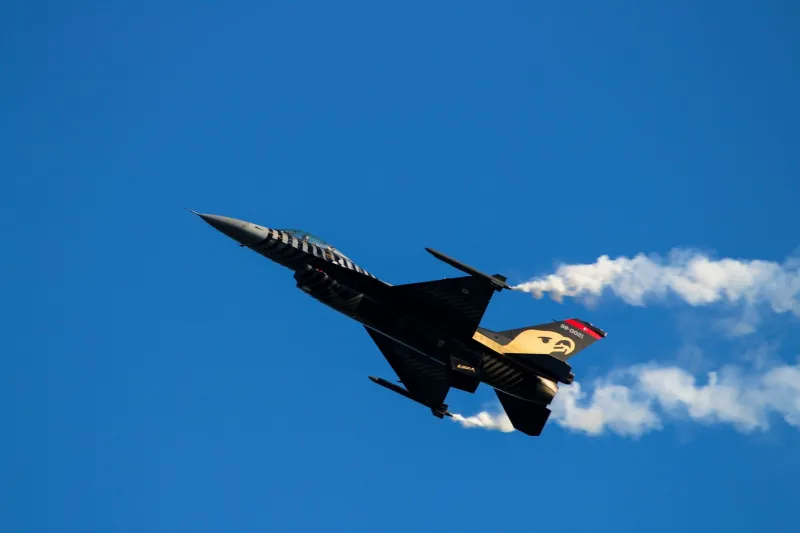
The Quiet Channel: Why Acoustic Sensing Belongs in the Stealth Conversation

Stealth is usually described as a problem of echoes and heat. Engineers shape metal to scatter radar energy away from a receiver, and they manage thermal loads so that an airframe does not glow against a cold sky. Both disciplines are mature, expensive, and central to how the United States builds and operates low-observable aircraft. Neither, however, describes the whole physical event of an aircraft moving through the atmosphere. A body traveling at speed displaces air, and that displacement propagates outward as pressure fluctuations. Long before radar, armies listened for engines and propellers with horns and microphones. The listening channel did not disappear when radar arrived; it was simply outcompeted for attention, funding, and prestige.
That calculation is worth revisiting. The sensors are now remarkably cheap, the computing is abundant, and the operational problem has shifted toward low-flying cruise missiles, unmanned systems, and aircraft that may be difficult to see but cannot easily avoid disturbing the air beneath them. Acoustic sensing will not replace radar. It does, however, represent a seam in low-observable operations that deserves honest treatment rather than dismissal.
An Old Sense, Newly Affordable
Acoustic air defense is not a novelty. During the First World War, sound locators—large horns and listening tubes—were used to detect approaching aircraft before visual or radar contact. Their limitations were obvious: wind noise, ambient sound, limited range, and the arrival delay imposed by the speed of sound. Radar made them obsolete for most tracking tasks.
The modern version is different in kind, not just degree. Microelectromechanical microphones, fiber-optic acoustic sensing, and compact infrasound arrays can be produced and deployed in large numbers. A distributed network can trade the sensitivity of a single large dish for the redundancy of many small, expendable nodes. Machine learning helps separate a faint, structured pressure signature from wind, traffic, insects, and the general rumble of the environment. The result is not a Cold War listening post, but a dense, software-defined field of inexpensive ears.
What the Air Remembers
An aircraft's acoustic signature is not a single number. It is a spectrum shaped by engine machinery, fan and compressor tones, jet mixing noise, propeller or rotor blade-passage frequencies, airframe turbulence, and, at very low frequencies, the pressure wave generated by a body moving through the atmosphere. Infrasound—sound below the threshold of human hearing—propagates over long distances with relatively little attenuation, which is why it has long interested researchers monitoring explosions, volcanoes, and atmospheric events.
For a stealth aircraft, the interesting question is not whether it is silent. It is not. The question is whether its acoustic emissions are distinctive enough, at militarily useful ranges, to be separated from background noise by a network that costs far less than a radar. In some flight regimes, the answer may be yes. A low-flying platform passing over a distributed array produces a moving pressure disturbance whose coherence across sensors can be exploited. The signal may be weak, but weakness is a processing problem, not necessarily a disqualifying one.
The Physics That Refuses to Cooperate
Acoustic detection has stubborn limits, and any serious discussion has to state them plainly. The atmosphere is a noisy, variable medium. Temperature inversions, wind shear, and turbulence bend and scatter sound in ways that are difficult to model precisely. A microphone array in a windy environment must contend with flow noise that can swamp the signal of interest. Localization requires accurate time-of-arrival information across multiple sensors, and the speed of sound—roughly 343 meters per second at sea level—imposes a delay that matters for fast-moving targets. A network may know that something passed, and roughly where, while the aircraft is already gone.
Range is the other constraint. High-frequency engine tones attenuate quickly. Low-frequency content travels farther but is harder to localize with small arrays and more easily confused with natural and industrial sources. The result is a sensing channel that is better suited to detection and cueing than to continuous weapons-quality tracking. That is not a fatal weakness. It is a definition of the role.
A Cue, Not a Kill Chain
The most useful way to think about acoustic sensing is as a complement to conventional networks. A radar may be jammed, a datalink may be degraded, and an infrared sensor may be defeated by clouds or geometry. An acoustic array listens passively, emits nothing, and can be made difficult to find and attack. Its output can cue a radar to a particular volume of airspace, or corroborate a track that other sensors have already established.
For homeland air defense, the appeal is straightforward. The United States has an enormous airspace and a comparatively small number of fixed radars optimized for conventional air threats. Distributed acoustic nodes—along borders, around critical infrastructure, or deployed tactically—could add a low-cost layer that raises the difficulty of a surprise low-altitude approach. For counter-unmanned systems, the same logic applies at shorter range. Small drones are acoustically noisy, and a dense field of microphones may detect them without the cost and complexity of a radar for every site.
The military application is more delicate. A stealth aircraft's acoustic signature is one more observable that an adversary might exploit, and the United States should treat it as such. Signature management has traditionally focused on radar and infrared. It may need to include the pressure field as well, particularly for platforms that operate at low altitude, where the air is dense and the propagation path to a listener is short.
Why the Quiet Seam Matters
None of this suggests that acoustic networks will make stealth obsolete. They will not. The physics is too variable, the ranges too modest, and the processing too dependent on environmental conditions for that claim to survive contact with reality. But the opposite claim—that acoustics is irrelevant because radar is better—is also too simple. Adversaries do not need a perfect sensor. They need a cue, a corroborating data point, or a reason to assign scarce defensive resources to a particular piece of sky.
A microphone network that costs a fraction of a radar and can be scattered across a landscape is exactly the kind of capability that proliferates. It is also the kind of capability that American planners tend to undervalue because it does not fit the dominant radar-and-infrared template. The quieter channel is not a replacement for the loud ones. It is a reminder that an aircraft cannot hide from every physical property it possesses, and that the atmosphere beneath a low-flying jet is still a medium that carries information.