Radio Silence as a Skill: The Quiet Revolution in Stealth Pilot Training
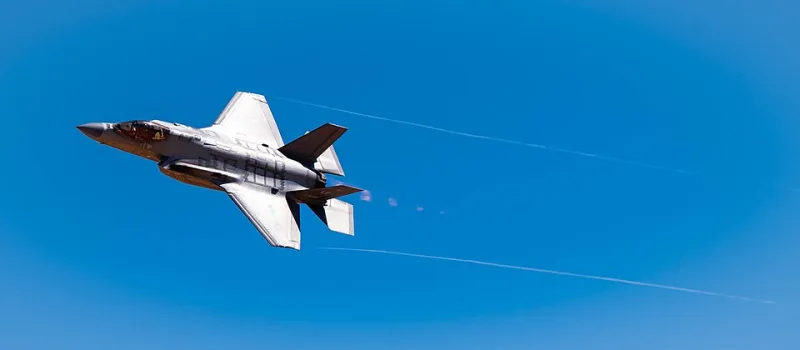
Photo: Airman 1st Class Mason Hargrove, Public domain, via Wikimedia Commons
For most of aviation history, a fighter pilot's survival depended on being heard: a loud radio call, a hard spike on radar, a wingman shouting a tally. Low observable flight inverted that logic entirely. In a fifth-generation cockpit, the most dangerous sound is any sound at all.
The Doctrine of Saying Nothing
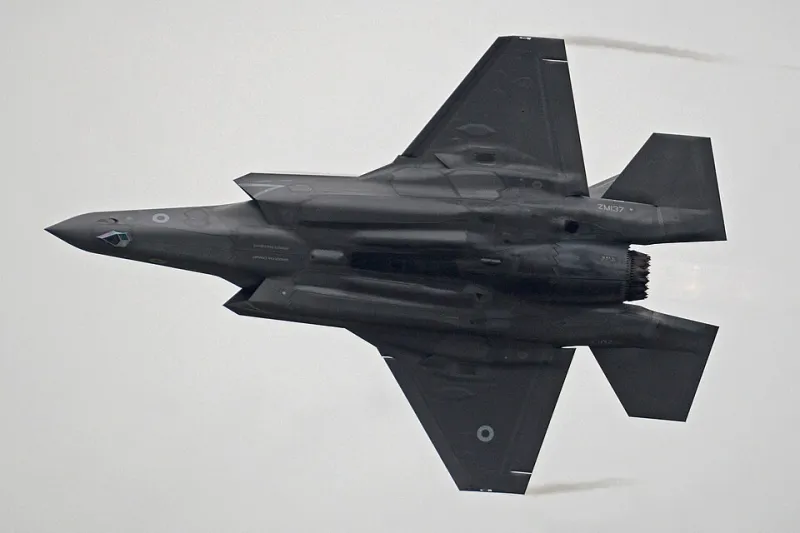
Emission control, or EMCON, is not a new concept — the Navy has practiced it since the days of radar picket ships. What is new is how central it has become to tactical aviation. An F-35's active electronically scanned array can passively track targets across a wide battlespace without ever painting a hostile radar. When the jet does transmit, it does so in tightly managed, low-probability-of-intercept bursts. Every emission is a budgeted expense, and pilots are trained to spend it like money.
That discipline extends well beyond the radar. Data links, jamming pods, even the radar altimeter all radiate. Mission planning for a stealth sortie begins weeks before takeoff with an emissions plan: which systems transmit, when, and under what contingencies. In a well-run fourth-generation flight, the lead calls a picture update every thirty seconds. In a fifth-generation package, silence is often the picture.
Teaching Pilots to Be Quiet
Adapting training culture to that reality has taken two decades. At Nellis Air Force Base, home of the Air Force Weapons School, exercises like Red Flag now build EMCON violations into debrief scoring with the same severity as a missed target. Instructors grade not just what a student did, but what the student broadcast while doing it.
The challenge is pedagogical as much as technical. Fourth-generation pilots learned to trust their radar and their radio; fifth-generation students must learn to trust fusion — the quiet, passive picture assembled by the aircraft and its offboard sensors. Weapons school syllabi increasingly emphasize passive sensor geometry, cooperative terrain masking between stealth and non-stealth wingmen, and the choreography of a 'comm window': brief, pre-planned transmission periods where the flight goes loud for seconds at a time.
Formation flying changed too. Legacy tactics put four ships in a tight, mutually supporting visual box. Stealth tactics disperse the flight across tens of miles, linked silently by data. The wingman is no longer a shape off the left wing but an icon on a display — and pilots train to resist the instinct to close the distance just because they can't see him.
When the Discipline Breaks
What happens when it fails? A single unguarded radio transmission or an active radar lock held too long can give an integrated air defense system a line of bearing — and modern emitters networked across a defended area can turn a bearing into a firing solution with surprising speed. Training ranges simulate this deliberately: aggressor squadrons at Nellis and Eielson now fly with equipment and tactics modeled on modern threat networks, and a stealth student who breaks EMCON can expect to be 'shot down' by sensors that never once transmitted themselves.
The debrief is where the culture lives. Pilots review recorded emissions line by line, reconstructing every transmission against the threat picture. It is a humbling exercise — the kind where a two-second lapse unravels an otherwise flawless two-hour sortie.
The Human Factor
There is an irony at the heart of stealth training: the aircraft was designed to be invisible, but the pilot remains stubbornly human. Radios get keyed out of habit. Eyes wander to the wingman. The service's answer has been to build silence into muscle memory the way it once built checklists there — simulators that penalize emissions, syllabi that reward the pilot who says nothing and sees everything.
Low observability, in the end, is not a coating or a shape. It is a discipline practiced by people, rehearsed until the quiet becomes instinct. The jets were engineered to disappear; the training exists to make sure the pilots don't bring them back by talking.