The Heat Is On: Why Infrared Is Stealth's Uncomfortable Blind Spot
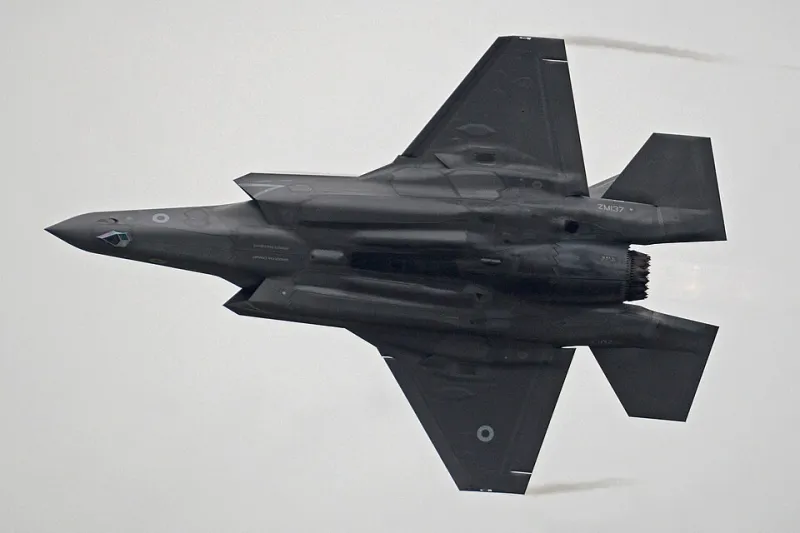
Photo: Alan Wilson from Stilton, Peterborough, Cambs, UK, CC BY-SA 2.0, via Wikimedia Commons
For four decades, the public understanding of stealth has been built on a single number: radar cross-section. It's the statistic quoted in congressional hearings, the figure defense journalists parse in every program review, and the yardstick against which the F-22, F-35, and now B-21 Raider are measured. But ask any signature management engineer where the sleepless nights come from, and the answer increasingly isn't radar.
It's heat.
The Physics That Won't Cooperate
Radar evasion is, at its core, a geometry and materials problem. Shape a aircraft to deflect incident energy away from the emitter, coat it with radar-absorbent materials, and the return signal shrinks dramatically. Difficult, yes — but tractable.
Infrared signature is a different animal entirely. A fighter moving at combat speed generates heat from nearly every surface: the exhaust plume, the engine's hot sections, the leading edges warmed by supersonic friction, even the avionics bays that must dump waste heat somewhere. Unlike radio waves, infrared energy is emitted passively. There is no shaping it away from a receiver, because the target itself is the source.
The detection physics compound the problem. Radar range falls off with the fourth power of distance, but passive infrared detection follows an inverse-square law — a fundamentally more forgiving curve for the sensor operator. An adversary's infrared search-and-track (IRST) system doesn't broadcast anything, meaning no warning, no radar warning receiver chirp, no electronic warfare response. The first indication a pilot has of being tracked may be a missile launch.
What the Fleet Actually Does About It
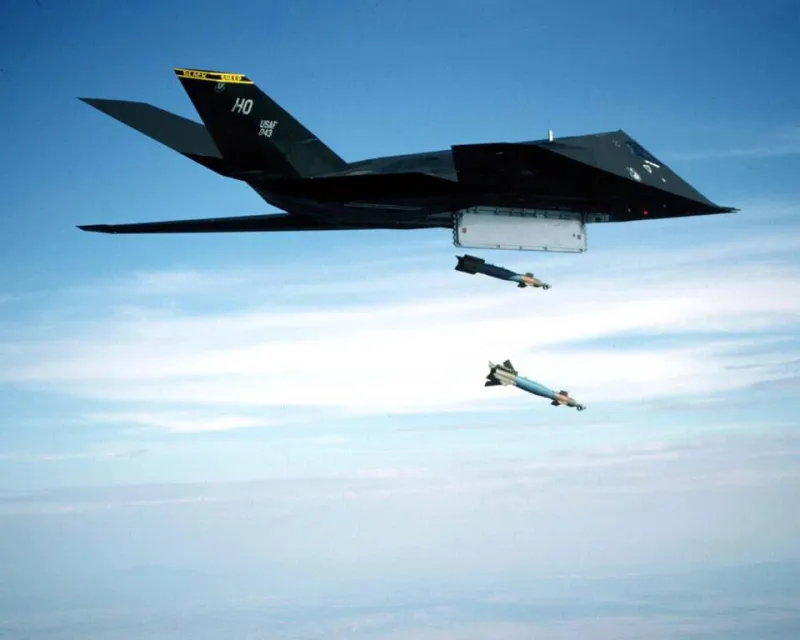
The US approach to infrared suppression has evolved considerably since the F-117 Nighthawk flew with a rudimentary exhaust-cooling scheme in the 1980s. The F-22's rectangular, saw-toothed nozzles mix cool bypass air into the exhaust stream while shielding the hot turbine faces from direct line-of-sight observation — a design choice that sacrifices some thrust efficiency for signature reduction.
The F-35 refines this further. Lockheed Martin's engineers shaped the exhaust to obscure the engine's hottest components, and the aircraft's skin materials were selected partly for their thermal properties. Perhaps more importantly, the jet's sensor fusion and DAS (Distributed Aperture System) give pilots awareness of infrared threats, acknowledging that the threat is real enough to warrant dedicated countermeasures.
The B-21 Raider, revealed publicly in 2022, is widely believed to push exhaust treatment and thermal management to new extremes, though details remain among the most closely guarded aspects of the program. What can be said with confidence: for a penetrator designed to operate over the Pacific's vast distances, infrared discipline isn't optional. China's expanding fleet of J-20s and J-31s, paired with increasingly capable IRST pods and long-wave infrared missiles, makes the Pacific theater the planet's most demanding thermal environment.
The IRST Renaissance
For years, infrared search-and-track was dismissed in some quarters as a legacy technology — useful for visual-range identification, irrelevant against modern stealth. That assessment has aged poorly.
Modern long-wave IRST sensors can detect cooler signatures at tactically meaningful ranges, particularly against an aircraft's skin friction heating during high-speed flight. Russia's Su-35 and Su-57 carry IRST balls; European operators are fielding the Skyward and PIRATE systems; and China's domestic sensors have improved markedly. The Navy's own decision to equip Super Hornets with the Block II IRST pod reflects a quiet admission that passive infrared detection has returned to the front rank of air-to-air threats.
The implication is uncomfortable for the stealth establishment: an aircraft that is invisible to radar but glowing in long-wave infrared is no longer invisible at all. It is merely visible to a different set of eyes, at different ranges, under different conditions.
Redefining Low Observable
None of this renders radar stealth obsolete. The F-35's radar cross-section still shapes the engagement geometry in ways that matter enormously — forcing adversaries to close distance, compressing reaction times, and degrading the integrated air defense picture. Signature management has always been about shifting the terms of engagement, not achieving literal invisibility.
But the conversation needs updating. The next generation of American aircraft — whether the Navy's F/A-XX or the Air Force's efforts under NGAD — will be judged less by a single RCS figure and more by a full-spectrum signature profile: radar, infrared, radio-frequency emissions, even acoustic and visual signatures. The Air Force has begun acknowledging this in program language, though the specifics remain classified.
The uncomfortable truth is that infrared may be the domain where the offense holds a durable advantage. Exhaust plumes can be cooled and shielded, but never eliminated. As sensor resolution improves and missile seekers gain sensitivity, the margin between detected and undetected will keep narrowing.
Seeing the unseen was the founding promise of stealth. Keeping it unseen in the infrared band may be the defining engineering challenge of the next twenty years — and it's the gap far too few are talking about.