The Atmosphere as Witness: Contrails, Wake Vortices, and the Signature the Airframe Leaves Behind
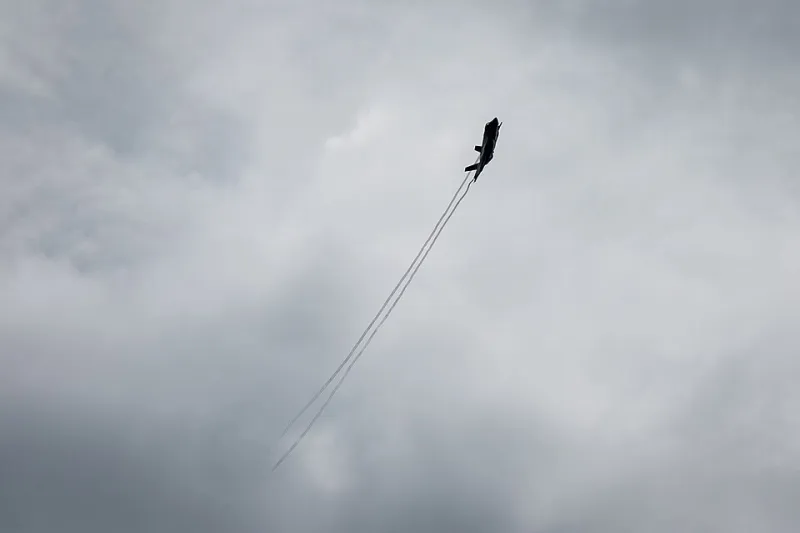
Photo: Staff Sgt. Sarah McClanahan, Public domain, via Wikimedia Commons
Low observability is usually discussed as a property of the airframe: angles, materials, edge treatments, engine inlet geometry, and the careful management of seams. That framing is necessary, but incomplete. An aircraft also moves through a medium that can retain evidence of its passage. Contrails, wake vortices, condensation clouds, and persistent disturbances in the atmosphere can create a signature that outlasts the vehicle and, in some conditions, points back to it.
The distinction matters because signature management is not only about what a radar sees against an airframe. It is also about what an observer can infer from the air itself. A low-observable aircraft may be difficult to track directly while still leaving a visible or detectable atmospheric trace. In that sense, the sky is not a passive backdrop. It is a recording medium.
The Contrail Problem Is a Routing Problem
Contrails form when hot, moist engine exhaust mixes with cold ambient air and crosses a threshold of temperature and humidity. The result can be a short-lived wisp or a persistent ice cloud that spreads across the sky. For commercial aviation, contrail avoidance has become a subject of climate research and trial routing. For military aviation, the same physics applies, even if the operational calculus is different.
A stealth aircraft is not exempt from producing water vapor and soot. Its engines may be designed to reduce certain observable signatures, but they still emit exhaust. In an ice-supersaturated region, that exhaust can leave a line in the sky that is visible to the eye, to optical sensors, and potentially to other detection layers. The contrail does not need to reveal the aircraft's shape to be useful. It can reveal that something passed, roughly where, and in which direction.
This is why altitude and route selection become signature-management decisions. A flight profile that is optimal for fuel or range may be poor for atmospheric discretion. Conversely, avoiding a contrail-producing layer may impose penalties in fuel, time, or mission flexibility. The tradeoff is not theoretical; it is part of the quiet planning work that sits behind a low-observable sortie.
Wake Vortices and the Invisible Wingtip
Contrails are the most familiar atmospheric tell, but they are not the only one. Any lifting wing generates wake vortices, and those vortices can persist after the aircraft has moved on. In certain conditions, they disturb cloud layers, entrain moisture, or create clear-air turbulence that can be detected by sensitive instruments.
Wake vortices are an aerodynamic inevitability. Shaping can reduce radar cross section, but it does not eliminate the lift that keeps an aircraft airborne. The vortex pair trailing from wingtips is a physical consequence of generating lift. Research and field experiments have shown that wake vortices can be sensed by lidar and other remote techniques, particularly when they carry aerosols or disturb stratified atmospheric layers. The detection problem is not trivial, and operational ranges vary widely with weather and sensor placement. But the principle is important: an aircraft can be low-observable to radar while still leaving an aerodynamic signature in its wake.
For an adversary, a wake detection may not provide a precise track. It can still provide a cue. A persistent vortex line can narrow the search area, suggest a heading, or confirm that an aircraft passed through a particular corridor. In a layered sensing environment, that kind of cue can be enough to task other sensors.
Condensation and the Aerodynamic Outline
There is also the transient signature of condensation. In humid air, low pressure over a wing or around a control surface can cause water vapor to condense, producing vapor cones or patches of cloud that briefly outline the aircraft. These effects are often associated with transonic flight, but they are not limited to it. Aerodynamic flow visualization in the atmosphere can occur at lower speeds when temperature and humidity cooperate.
A brief condensation cloud may seem inconsequential. But it can reveal planform, orientation, and maneuvering state at a moment when the aircraft is otherwise trying to remain discreet. The effect is fleeting, yet it illustrates a broader point: the atmosphere can act as a flow-visualization medium, and flow visualization is a form of signature.
The Atmosphere as a Detection Layer
Contrails, wake vortices, and condensation are different phenomena, but they share a common implication. They move the signature problem beyond the skin of the aircraft and into the environment. Optical sensors can see contrails. Lidar can probe wake vortices. Weather satellites and cloud imagery can reveal persistent disturbances. Data fusion can connect an atmospheric anomaly to a likely aircraft track even when direct radar detection is intermittent.
As of 2026, weather-aware mission planning has become more practical. High-resolution atmospheric models and commercial weather data can identify ice-supersaturated regions, humidity layers, and wind conditions that favor persistent contrails or vortex detection. The question is no longer whether the atmosphere can be modeled. It is whether atmospheric signature effects are integrated into the same trade studies that govern route, altitude, and sensor employment.
Managing the Unshaped
Stealth aircraft are designed to manage their electromagnetic signature. They are not designed to eliminate their atmospheric one. That asymmetry is worth confronting. A low-observable aircraft can be shaped for radar and still produce a contrail, a wake, or a condensation cloud that betrays its passage.
The solution is not a single technology. It is a planning discipline that treats the atmosphere as part of the signature problem. That means weather-aware routing, altitude selection, engine management, and an understanding of how atmospheric conditions interact with the aircraft's flight profile. It also means acknowledging that some atmospheric tells cannot be shaped away. They can only be avoided, minimized, or accepted as a residual risk.
Low observability is often described as a property of the vehicle. In practice, it is a relationship between the vehicle, the atmosphere, and the observer. The airframe may be quiet. The sky, under the wrong conditions, is not.